Saju Basics
Saju vs Western Astrology: What's the Real Difference?
SajuClarity Editorial · June 18, 2026
If you already know your sun sign, the quickest way to understand Saju is this: where Western astrology usually sorts people into one of twelve signs, Saju (四柱, the Korean Four Pillars of Destiny) reads the exact year, month, day, and hour of your birth — building a far more individual chart. Both systems map character and timing. Saju simply works at a finer resolution, and it leans harder on when things happen across a life.
Here's the honest, side-by-side version.
What each system is built from
Western astrology, in its popular form, places the Sun in one of twelve zodiac signs based on your birth date. A full natal chart goes further — adding the Moon, the planets, and the houses — but the version most people carry around is the single sun sign.
Saju builds four "pillars" — one each for your birth year, month, day, and hour. Every pillar holds two characters: a Heavenly Stem (天干) on top and an Earthly Branch (地支) below. That's eight characters in total, which is why the system's full name is Saju Palja (四柱八字), literally "four pillars, eight characters." The Earthly Branches are also the familiar zodiac animals, so the animal year you may already know is just one of those eight characters.
The most important character: your Day Master
In a natal chart, no single planet is "you." In Saju, one character is: the Heavenly Stem of your Day Pillar, called the Day Master (日干). It represents your core nature, and everything else in the chart is interpreted in relation to it.
There are exactly ten Heavenly Stems — each of the Five Elements (五行) appearing in both a Yang and a Yin form:
| Element | Yang | Yin |
|---|---|---|
| Wood | 甲 | 乙 |
| Fire | 丙 | 丁 |
| Earth | 戊 | 己 |
| Metal | 庚 | 辛 |
| Water | 壬 | 癸 |
So your Day Master isn't "Fire" in the abstract — it's specifically Yang Fire (丙, the blazing bonfire) or Yin Fire (丁, the steady candle). That distinction alone already says more about temperament than a twelve-way split can.
Granularity: twelve signs vs hundreds of thousands of charts
This is the difference people feel most. Western sun-sign astrology gives you one of twelve types. Because Saju adds the birth hour and reads the interplay of all eight characters, it produces hundreds of thousands of distinct base charts — a figure often cited as around 518,400.
Two people born on the same day can still hold different Day Masters and element balances once the hour is included, and Saju reads them as genuinely different people. That granularity is the whole point: it's less "what's your sign" and closer to a structured profile of one specific birth moment.
What each system actually reads
The interpretive engines differ, too.
- Western astrology reads planetary aspects — conjunctions, squares, trines — angles between planets in your chart.
- Saju reads the Five Elements through their generating and controlling cycles, the Ten Gods (十星) (the roles other elements play toward your Day Master), and the flow of 10-year Luck Pillars and yearly cycles.
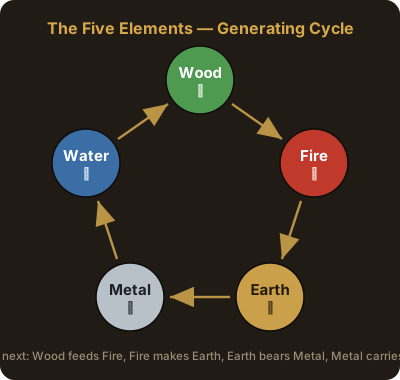 The Five Elements and their generating cycle — the engine a Saju reading runs on. (Original diagram.)
In other words, Western astrology often asks what is the shape of your inner world, while Saju asks how do your elements balance, and how does that balance move through time.
Time is where Saju leans in
Both systems care about timing, but Saju makes it central. The Luck Pillars divide life into roughly ten-year chapters, each coloring how your fixed chart expresses itself. This is why a Saju reading so often sounds practical — career windows, relationship seasons, years that favor building versus consolidating — rather than purely characterological.
None of this is fixed fate. A chart describes tendencies and timing, not a script; the useful reading tells you how to work with a season, not that anything is guaranteed.
So which should you use?
They're not rivals, and you don't have to choose. Many people enjoy Western astrology for its psychological, metaphorical language and turn to Saju when they want a more individualized, timing-aware read tied to their exact birth hour. If your question is "what's my personality vibe," a sun sign is a fun start. If it's "what does my specific chart say, and what's the timing," that's Saju's home turf.
See your own chart. You can generate your full Four Pillars chart for free at SajuClarity and see your Day Master, your Five Elements balance, and more — the exact, hour-precise version of what we compared above.
Frequently asked questions
Is Saju more accurate than Western astrology? Neither has been proven superior by science. What's objectively true is that Saju is more granular: it uses your birth hour and eight characters, so it distinguishes far more individual charts than a twelve-sign system. Whether that feels "more accurate" depends on what you want from a reading.
Is Saju the same as Chinese astrology / BaZi? They share the same Four Pillars framework. "Saju" is the Korean name and tradition; "BaZi" is the Chinese name for the same eight-character system, with some interpretive differences.
Do I need my exact birth time for Saju? Ideally yes. The hour sets your Hour Pillar and can shift your overall balance, so an accurate birth time makes the reading meaningfully more precise than date alone.
See it in your own chart
Start free — build your Saju chart in seconds. Ready for the full picture? The complete 15-chapter reading interprets all of it: who you are, how you love and work, and the years ahead.