Saju Basics
What Is a Day Master in Saju? The Most Important Character in Your Chart
SajuClarity Editorial · June 22, 2026
If you've started exploring Saju (사주, the Korean reading of the Four Pillars of Destiny), you've probably bumped into a phrase that keeps coming up: the Day Master. So what is it, and why does everyone treat it as the heart of the chart?
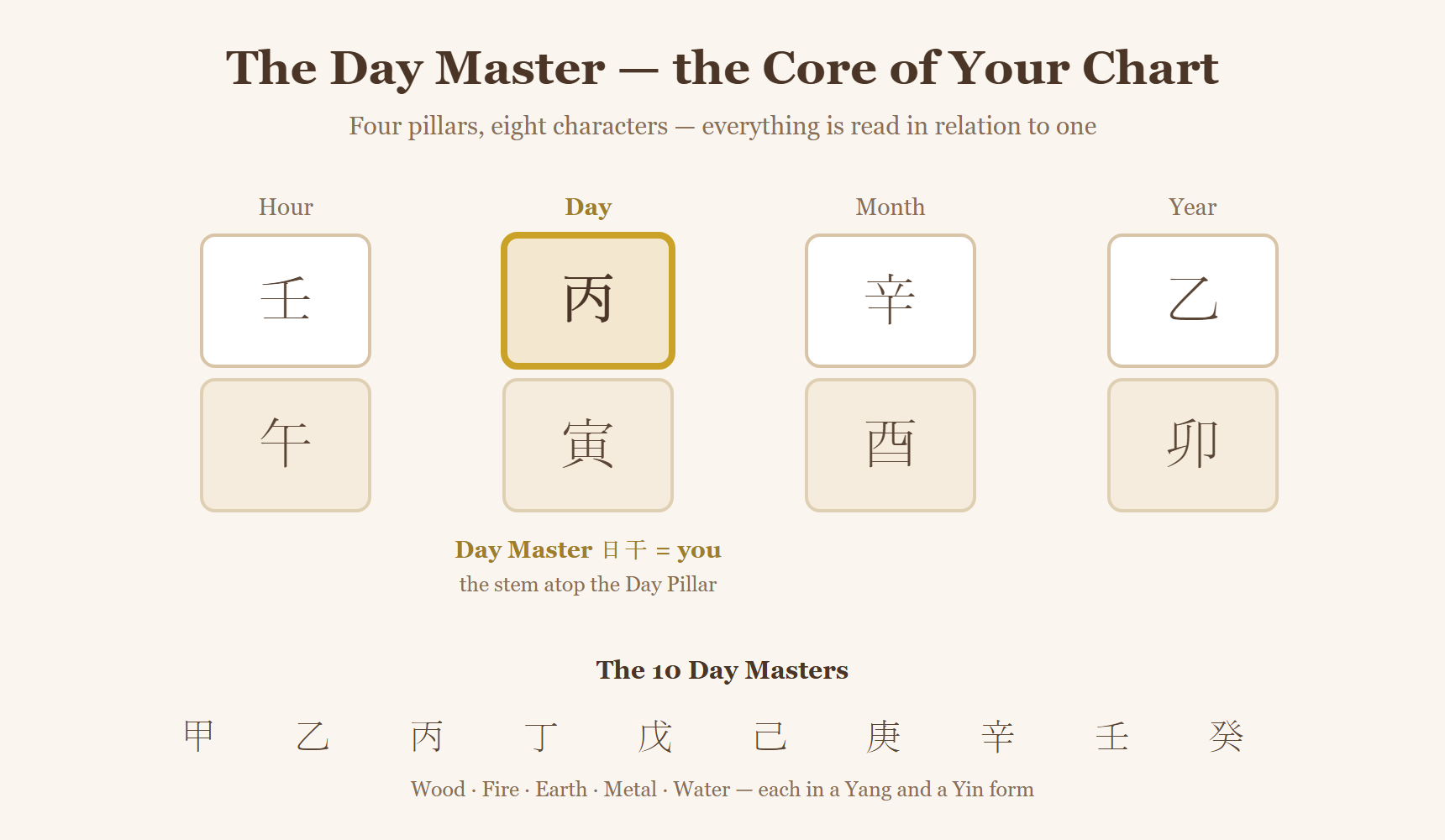
The Day Master (日干, also called the ilgan — 일간) is the single Heavenly Stem that sits on top of your Day Pillar. In plain terms, it represents you — your core self, your natural temperament, the lens through which every other part of the chart is interpreted. It matters most because in Saju nothing is read in isolation: every other element, relationship, and tendency in your chart is measured in relation to this one character. Get the Day Master right, and the rest of the reading falls into place.
Let's unpack what that actually means.
How a Saju Chart Is Built
A full Saju chart is made of four pillars: the year, the month, the day, and the hour of your birth. Each pillar has two parts stacked on top of each other:
- a Heavenly Stem (天干, cheongan — 천간) on top, and
- an Earthly Branch (地支, jiji — 지지) underneath.
Four pillars × two characters = eight characters total. This is why Saju is sometimes called the "Eight Characters" system (the Chinese term is BaZi).
Out of all eight, one character is singled out as you: the Heavenly Stem on the Day Pillar. That's your Day Master. The year speaks to ancestry and early environment, the month to your social and seasonal context, the hour to your later years and inner world — but the day's stem is the "I" at the center of it all.
The 10 Day Masters: Five Elements in Two Flavors
Here's the part that surprises newcomers. There are only ten possible Day Masters — not hundreds. That's because the ten Heavenly Stems are simply the Five Elements (Wood, Fire, Earth, Metal, Water), each appearing in a Yang (active, outward) and a Yin (receptive, inward) form.
So your core self is always one of these ten:
| Stem | Element & Polarity | Light Imagery |
|---|---|---|
| 甲 (gap) | Yang Wood | a tall, upright tree |
| 乙 (eul) | Yin Wood | a vine or flower |
| 丙 (byeong) | Yang Fire | the sun, a bonfire |
| 丁 (jeong) | Yin Fire | a candle flame |
| 戊 (mu) | Yang Earth | a mountain |
| 己 (gi) | Yin Earth | garden soil |
| 庚 (gyeong) | Yang Metal | raw metal, an axe |
| 辛 (sin) | Yin Metal | a polished jewel |
| 壬 (im) | Yang Water | the ocean |
| 癸 (gye) | Yin Water | dew or gentle rain |
Notice how the imagery shifts the feel of the same element. Yang Wood (甲) is a tree that grows straight and tall, drawn to structure and direction. Yin Wood (乙) is a vine that adapts, weaves, and finds its way around obstacles. Both are "Wood," but they move through life differently — one assertive, one flexible. The same logic applies across all five elements.
These pictures are illustrative, not literal. A Yin Water person isn't "made of rain." The imagery is just a memorable shorthand for tendencies — how someone tends to express energy, handle pressure, and relate to others.
Curious which of the ten is yours? You can see your own Day Master in seconds — free at SajuClarity and follow along with the rest of this article.
Why the Day Master Is the Reference Point
Once your Day Master is known, the chart stops being a random pile of symbols and becomes a story with a main character. Every other element is read by how it relates to your Day Master — and there are really just four kinds of relationship:
- Elements that generate it — these nourish and support your core self (think of water feeding wood).
- Elements it generates — these drain or express your energy outward (wood feeding fire).
- Elements that control it — these challenge or discipline you (metal cutting wood).
- Elements it controls — these are what you act upon and manage (wood breaking up earth).
This web of relationships is the foundation of the Ten Gods (十성, sipseong — 십성), the classical framework that turns raw elements into meaningful life themes: support, creativity, wealth, authority, and so on. You don't need to memorize the Ten Gods to benefit from the idea. Just hold onto the key insight: the same element means different things to different people, depending on what their Day Master is.
Fire, for instance, is a source of warmth and recognition to a Wood Day Master (wood feeds fire, so fire is its self-expression). But to a Metal Day Master, fire is the force that controls and refines it (fire melts metal). Same element, completely different role — because the reference point changed.
This is exactly why two people can share the "same element" in their chart and still live it out in opposite ways.
"We Were Born the Same Day — Do We Have the Same Chart?"
Not necessarily. Sharing a birth date means you share a Day Pillar, and therefore the same Day Master — a meaningful similarity. But a complete chart also depends on the hour of birth, which sets the Hour Pillar and shifts the balance of the whole chart.
Two people born on the same day but at different hours will have different hour pillars, often different elemental balances, and different overall dynamics. The Day Master is the same headline; the full story still differs. This is part of why accuracy matters so much in Saju — small details in the birth data change the reading in real ways.
A Tendency, Not a Verdict
One thing to keep clear: your Day Master describes a tendency, not a sentence. It's not a label that locks you into one fate, and a "strong" or "weak" Day Master isn't good or bad — those are just descriptions of balance, like saying a season is dry or wet.
A Yang Fire person isn't guaranteed to be a charismatic leader, and a Yin Earth person isn't doomed to fade into the background. The chart sketches your natural grain — the direction you move most easily — while leaving plenty of room for choice, growth, and circumstance. Think of it as understanding your default settings, not reading a script you can't edit.
That's the real value of knowing your Day Master: it gives you language for who you naturally are, so you can lean into your strengths and work with your nature instead of against it.
Frequently Asked Questions
What is the Day Master in Saju?
The Day Master (ilgan) is the Heavenly Stem on top of your Day Pillar — the single character in your chart that represents you, your core self. Every other element in the chart is interpreted in relation to it, which is why it's considered the most important character.
How many Day Masters are there?
Exactly ten. They are the five elements (Wood, Fire, Earth, Metal, Water), each in a Yang and a Yin form: 甲 Yang Wood, 乙 Yin Wood, 丙 Yang Fire, 丁 Yin Fire, 戊 Yang Earth, 己 Yin Earth, 庚 Yang Metal, 辛 Yin Metal, 壬 Yang Water, and 癸 Yin Water.
Does my Day Master decide my fate?
No. Your Day Master describes natural tendencies — your temperament and the way you tend to express energy — not a fixed destiny. It points to inclinations and strengths, while your choices and circumstances shape how the story actually unfolds.
Start With Your Own Core Element
The Day Master is the doorway to everything else in Saju. Once you know yours, the elements, seasons, and relationships in your chart start to make sense as one connected story rather than a list of symbols.
The easiest first step is simply to find out which of the ten you are. Discover your Day Master for free at SajuClarity — enter your birth details and meet the character at the center of your chart.
See it in your own chart
Start free — build your Saju chart in seconds. Ready for the full picture? The complete 15-chapter reading interprets all of it: who you are, how you love and work, and the years ahead.