Saju Basics
What Is Saju? A Beginner's Guide to the Korean Four Pillars of Destiny
SajuClarity Editorial · June 21, 2026
Saju (四柱) is a Korean system for reading a person's character and life timing from the exact moment they were born. It takes your birth year, month, day, and hour, turns each into a "pillar" of two characters, and interprets how those eight characters — and the five elemental energies behind them — balance and interact. It isn't crystal balls or spirits; it's closer to a structured profile built from your birth data. Here's how it works, in plain English.
What the word "Saju" actually means
"Saju" literally means four pillars. The fuller name is Saju Palja (四柱八字) — "four pillars, eight characters." That's the whole idea in one phrase: four pillars, and because each pillar is written with two Chinese characters, eight characters in total.
Those four pillars come straight from your birth moment:
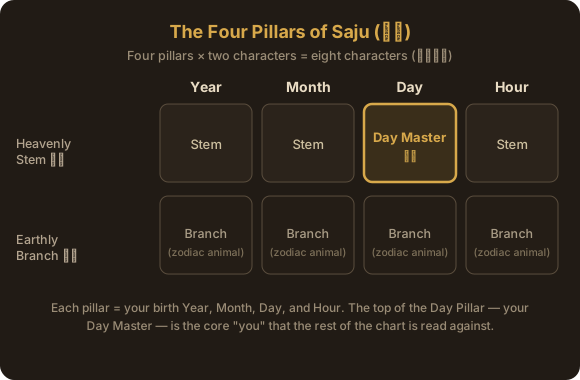 The anatomy of a Saju chart. (Original diagram.)
The four pillars: year, month, day, hour
Each pillar represents one layer of your birth time:
- The Year Pillar — your roots, ancestry, the broad backdrop you were born into.
- The Month Pillar — your upbringing, social environment, and career terrain.
- The Day Pillar — you, and your closest relationships (it holds the single most important character in the whole chart — more on that below).
- The Hour Pillar — your later years, inner drives, and what you build or leave behind.
This is why your exact birth time matters in Saju. Without the hour, you're missing a quarter of the chart — one of the four pillars simply isn't there.
Heavenly Stems and Earthly Branches
Each pillar stacks two characters: a Heavenly Stem (天干) on top and an Earthly Branch (地支) below.
There are ten Heavenly Stems — and here's the elegant part: they are simply each of the Five Elements (Wood, Fire, Earth, Metal, Water) in two flavors, a Yang (active) and a Yin (receptive) version. So "Fire" isn't one thing; it's either 丙 (Yang Fire, a blazing bonfire) or 丁 (Yin Fire, a steady candle).
There are twelve Earthly Branches — and you may already know these: they're the zodiac animals. The animal year people talk about is just one of these twelve branches:
| Branch | Animal | Element | Branch | Animal | Element | |
|---|---|---|---|---|---|---|
| 子 | Rat | Water | 午 | Horse | Fire | |
| 丑 | Ox | Earth | 未 | Goat | Earth | |
| 寅 | Tiger | Wood | 申 | Monkey | Metal | |
| 卯 | Rabbit | Wood | 酉 | Rooster | Metal | |
| 辰 | Dragon | Earth | 戌 | Dog | Earth | |
| 巳 | Snake | Fire | 亥 | Pig | Water |
So your eight characters are really eight little packets of elemental energy, each with its own flavor and timing.
Your Day Master: the heart of the chart
Of all eight characters, one is you: the Day Master (日干) — the Heavenly Stem sitting on top of your Day Pillar. It represents your core nature, your default setting.
Everything else in the chart is read in relation to your Day Master. Are the other elements feeding it, draining it, controlling it, or being controlled by it? That relationship is what produces the descriptions of your personality, your strengths, the areas where life asks more of you, and how your fortunes shift over time.
Because there are ten possible Day Masters (the ten stems), two people born on the very same day can still have different Day Masters once the hour and the full chart are considered — and Saju reads them as genuinely different people.
How a reading actually works
A Saju reading isn't about a single character meaning "lucky" or "unlucky." It's about balance. The practitioner looks at how the Five Elements are distributed across your eight characters — which are strong, which are missing, which support or clash — and reads the story that balance tells.
From there, the same framework extends through time: Saju maps out ten-year life chapters and yearly cycles, describing not just who you are but when certain energies come forward. That's why a good reading often sounds practical — seasons that favor building versus consolidating, windows for change — rather than vague.
And an honest word on tone: a chart describes tendencies and timing, not a fixed script. Nothing in Saju says you're doomed or guaranteed anything. The useful reading tells you how to work with a season, where your natural strengths lie, and where to bring a little extra care.
Is Saju fortune-telling?
Yes and no. It comes from the same East Asian tradition as fortune-telling, but there are no spirits or psychic powers involved. A skilled reader is running your birth data through a centuries-old analytical framework — much closer to a structured personality-and-timing assessment than a séance. That's exactly why it rewards precision: better birth data, better reading.
Curious what your own chart looks like? You can generate your full Four Pillars chart for free at SajuClarity — see your Day Master, your Five Elements balance, your stems and branches, and more, calculated to the hour.
Frequently asked questions
What does "Saju Palja" mean? "Four pillars, eight characters." Four pillars (year, month, day, hour), each written with two characters — a Heavenly Stem and an Earthly Branch — for eight characters total.
Do I need my exact birth time? Ideally yes. The hour forms your Hour Pillar and helps set your Day Master's context. Without it you're missing one of the four pillars, so the reading is less precise.
Is Saju the same as the Chinese zodiac? The zodiac animals are part of Saju — they're the twelve Earthly Branches — but Saju is much more than your animal year. It reads all eight characters and the Five Elements together.
Is Saju the same as BaZi? They're the same Four Pillars framework. "Saju" is the Korean name and tradition; "BaZi" is the Chinese name for the same eight-character system, with some differences in interpretation.
See it in your own chart
Start free — build your Saju chart in seconds. Ready for the full picture? The complete 15-chapter reading interprets all of it: who you are, how you love and work, and the years ahead.